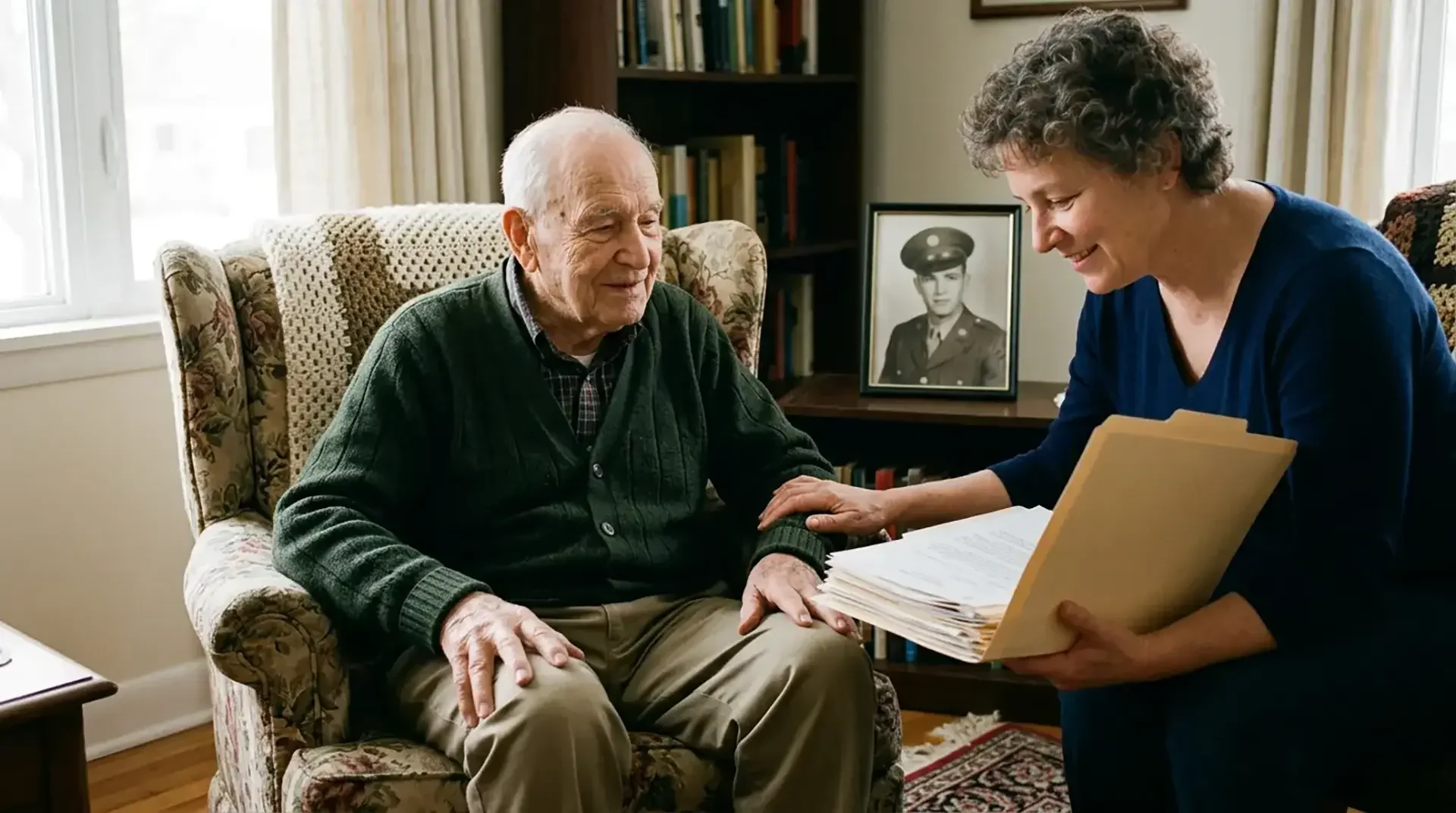
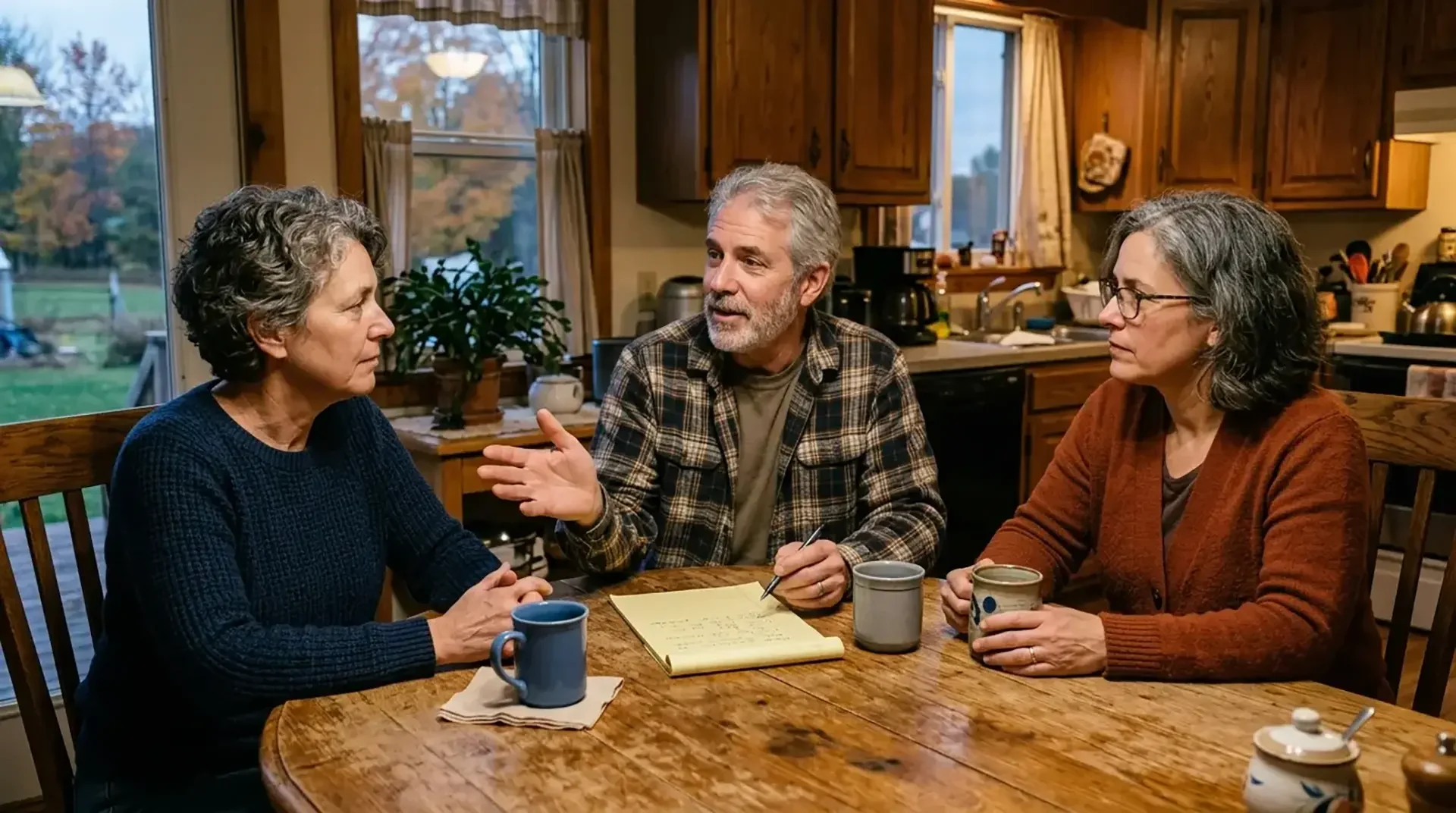
Nothing surfaces old family dynamics quite like a parent needing care. Suddenly the brother who left at eighteen and the sister who stayed are supposed to make joint decisions. The sibling who talks to Mom daily and the one who visits at Christmas are looking at two different mothers. And underneath the logistics, every unresolved thing from four decades of family life quietly takes a seat at the table.
If your family is stuck here, take some comfort in this: sibling disagreement over a parent’s care is one of the most common situations we encounter, in loving families as often as fractured ones. It is workable. But it helps enormously to understand why it happens before trying to fix it.
Why Good Families Disagree
You are looking at different data. The local sibling sees the daily reality: the near-misses, the confusion at dinner, the wear. The distant sibling sees Mom on her best behavior during a two-day visit, or hears her cheerful phone voice. Neither is lying. Older adults genuinely rally for visits and calls, so the distant sibling’s data really is rosier. Half of all sibling care conflicts are, at root, two people honestly describing two different datasets.
You have different relationships and histories. Each sibling has their own version of the parent, their own role in the family, and their own ledger of old grievances and closenesses. A care decision is never only a care decision; it lands on all of that.
The load is uneven, and unspoken. Very often one sibling, usually the nearest daughter, has quietly absorbed most of the work, and resentment compounds silently until it surfaces as conflict about something else. Meanwhile a distant sibling may be carrying unexpressed guilt that comes out as criticism of the care they are not providing.
Money is in the room. Care costs meet inheritance expectations meet unequal contributions. Even when nobody says it aloud, it is there.
What Helps
Get everyone the same information. Since divergent data drives so much conflict, the first fix is shared facts: a family meeting (video counts) where the day-to-day sibling walks through specifics, doctor’s notes shared with everyone, and where it is warranted, a professional assessment everyone can read. Facts do not settle everything, but they shrink the argument to what actually needs deciding.
Let equal be different. The fairest arrangements are almost never identical ones. Contributions can be time, money, or coordination: one sibling gives Tuesday and Thursday afternoons, another who lives far away funds the housekeeper, a third owns the paperwork and the pharmacy. What corrodes families is not different contributions; it is invisible ones. Name the loads out loud, and appreciate them out loud.
Center the parent, formally. The question is never “what do we want,” it is “what does Mom want, and what does she need?” Where documents exist, a healthcare proxy, a power of attorney, they name whose decision it legally is, which siblings should respect. And where the parent can speak for themselves, they get the loudest voice at the table, a point families under stress genuinely forget.
Handle the meeting like adults handling something hard. One conversation at a time, ideally scheduled rather than ambushed. Present-tense problems only; the 1987 material can wait forever. And decisions written down afterward, because memory under stress is a proven troublemaker.
When You Are Truly Stuck
Some impasses do not yield to good process, because the disagreement has become the relationship. This is where a neutral professional changes the physics of the room.
An independent assessment by a care manager replaces “your opinion versus mine” with an objective picture of what the parent actually needs, from someone with no side, no history, and no inheritance. It is remarkable how often the argument simply deflates once the facts arrive from outside the family. From there, a care manager can also carry the coordination itself, which removes the “who is in charge” fight entirely, and report to all siblings equally, which removes the information asymmetry that started much of the trouble.
We serve as exactly this neutral partner for Central New York families regularly, and our Aging Well Rochester team does the same in the Rochester area. Sometimes the kindest thing siblings can do for each other is stop asking each other to referee.
Frequently Asked Questions
Why do siblings disagree so often about a parent’s care?
Distance, different relationships with the parent, and different reads on how much help is needed all play a part. It is extremely common, and it is workable.
How do we divide caregiving fairly?
Remember that equal is not always fair: contributions can be time, money, or coordination. What matters is that everyone is contributing in some real way.
What if we are truly stuck?
A neutral professional assessment often resets the conversation, because it replaces opinions with a shared, objective picture.
An Objective Picture Moves Things Forward
When a family is at an impasse, an outside, objective read is often what moves things forward. We can be that neutral partner for your family. Reach out to the Reflections team at 315-497-7200 or send us a message.